
A Guide for Facility Buyers
Ultraviolet Light Disinfection: How It Works, What It Costs, and How to Specify It
Phones, tablets and shared handhelds pass from person to person all day long. Ultraviolet light disinfection adds one consistent, chemical-free step to that handoff — in seconds, with no dwell time to time and no residue to wipe off. Here is how the equipment works, what separates the categories, and what the published evidence actually shows.
- 99.99%† disinfection in a 15–60 second cycle
- Clinically studied at Harvard / Brigham & Women's and Children's Hospital Los Angeles
- Hands-free, chemical-free, no consumables to reorder
ExpressPro disinfects hard surfaces. It is not a sterilizer and not a medical device.
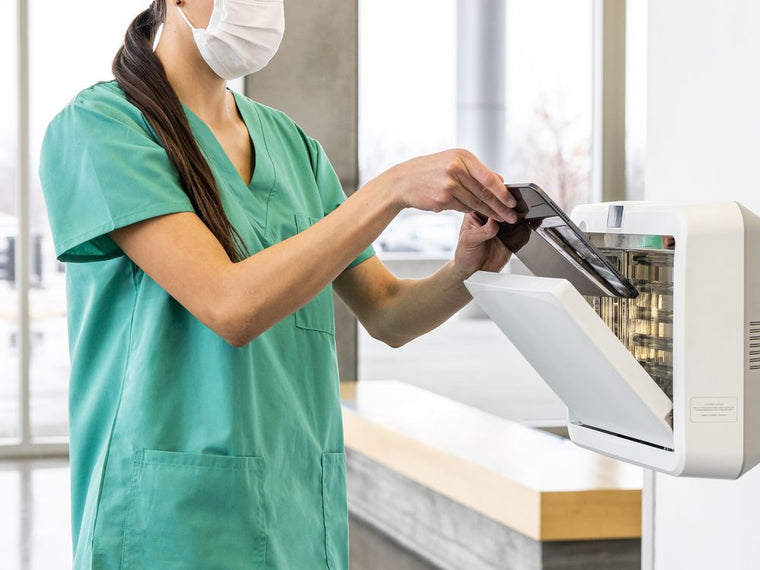
ExpressPro: Rapid UV Disinfector
Studied and published by
The Problem
The shared device is the third hand nobody washes.
Hand-hygiene protocol is mature and audited. Device hygiene mostly is not. A clinician sanitizes their hands, then picks up the same phone they were holding before — and the handoff starts over.
Wipes are the incumbent answer, and in a fast workflow they are hard to run correctly: the surface has to stay visibly wet for the full contact time on the label, which is usually minutes, not the few seconds a busy shift actually gives it. Miss the dwell time and the claim on the canister no longer applies.
Enclosed ultraviolet light disinfection removes the judgement call. The dose is fixed, the cycle is timed by the machine, and the result does not depend on who is holding the device.
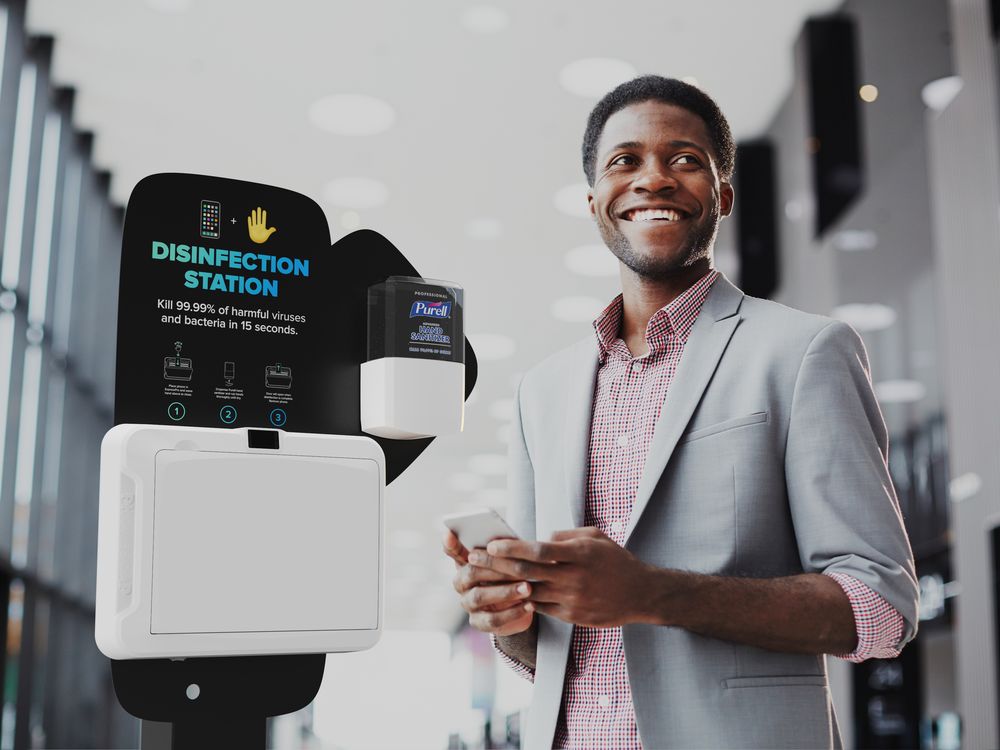
How It Works
Three variables decide whether ultraviolet light disinfection works.
UV-C is the short-wavelength band of ultraviolet light — germicidal light. At 254 nm it is absorbed by the nucleic acids inside bacteria, viruses and spores, damaging them so the organism can no longer replicate. That is the whole mechanism, and it is well established. What separates equipment that works from equipment that does not is whether it controls all three of the variables that mechanism depends on.
Wavelength
It has to be in the germicidal band. ExpressPro emits at 254 nm, the wavelength the published germicidal dose tables are built on. Not all "UV" marketing is UV-C.
Dose
Dose is intensity multiplied by time, and it is what the kill claim actually rests on. ExpressPro delivers 19.4 W of UV-C over a cycle the machine times itself — so the dose is repeatable rather than estimated.
Line of sight
UV-C only disinfects what the light reaches. Shadowed surfaces get nothing. ExpressPro uses 16 bulbs and real quartz shelving — quartz is UV-C transparent, so the light reaches the underside of the device too.
Enclosed chambers control all three. Handheld wands and open-room methods control none of them reliably, which is why their real-world results vary so much more than their lab results.
That is the equipment-selection version of the mechanism. For the underlying science — what UV-C actually does to a cell, the safety envelope and where the limits are — we keep a separate page.
Read how UV-C light works →Equipment
What counts as UV disinfection equipment — and what each type is actually for.
"UV disinfection equipment" covers five quite different categories of machine solving four different problems. Matching the category to the job matters more than comparing specs across categories.
Enclosed device chambers This is us
A sealed chamber sized for phones, tablets and handhelds. Seconds per cycle, fixed dose, 360° coverage, no line-of-sight guesswork. Sits at the point of care or the point of handoff. This is what ExpressPro is.
Storage & charging cabinets
Multi-bay cabinets that disinfect while they charge, sync and enforce device-management policy. Cycles run minutes rather than seconds. A genuinely different job — batch storage at shift change, not disinfection between two encounters five minutes apart.
Upper-room and in-duct fixtures
Fixed UV-C fixtures that treat air circulating above head height or inside ductwork. They run all day with people in the room. They do nothing for surfaces, and nothing for the device in someone's pocket.
Whole-room robots
Mobile towers that flood an empty room with UV-C between occupants. Effective for terminal cleaning, typically $8,000–10,000+, and they require the room to be vacated. Complementary to device disinfection, not a substitute for it.
Handheld wands
Operator-held UV-C lamps. Dose depends on how close, how slow and how thoroughly the person moves the wand, which makes results inconsistent by design. Some are app-verified to improve this; none remove the operator variable.
A facility disinfecting shared phones at the point of care and a facility turning over patient rooms are solving different problems, and most will end up with more than one of these. We build the first category and say so plainly.
Ultraviolet Light Disinfection vs. Wipes
Against the method almost everyone is using today.
Disinfecting wipes are the real incumbent, not competing UV equipment. Here is the honest comparison — including where wipes win.
| Enclosed UV-C cycle | Disinfecting wipes | |
|---|---|---|
| Time per device | 15–60 seconds, timed by the machine | Seconds to apply, then minutes of dwell time on most labels |
| Consistency | Fixed dose every cycle | Depends on saturation, coverage and dwell |
| Operator variable | None — wave and walk away | High — technique and time pressure |
| Chemical residue | None | Yes, on screens and in the air |
| Device wear | No effect on screens, coatings or plastics | Oleophobic coatings and port seals degrade over time |
| Coverage | 360°, including the back and edges | Only where the cloth reaches |
| Removes visible soil | No — UV-C does not remove soil | Yes |
| Recurring cost | None — no consumables | Ongoing canister spend and waste stream |
| Documentation | Cycle counts in the companion app; lab reports on file | Label claim only; no record of what was actually done |
Where wipes win, and it matters: UV-C does not remove visible soil, fingerprints or spills, and light cannot pass through what it cannot penetrate. A visibly soiled device needs to be wiped before it is disinfected. The two methods are not alternatives — the workable protocol in most facilities is wipes for soiling and UV-C for the consistent step between encounters.
Ultraviolet light disinfection also does not replace a facility's cleaning protocol. It adds a layer for the shared electronics that protocol has historically skipped.
Evidence
Independently studied, in real clinical settings.
Four independent bodies have published on UV-C disinfection of shared clinical devices using our equipment. The primary documents are downloadable on the ExpressPro product page.
Children's Hospital Los Angeles
90.5% reduction in total bacteria after a single 30-second cycle, rising to up to 99.9% after two. Pathogenic bacteria specifically were reduced by more than 99.99%.
CHLA, paper in press, 2020Harvard Medical School / Brigham & Women's
A UV-C device used between patient encounters significantly reduced bacterial contamination on medical tablets, on a 30-second disinfection cycle.
Published in the Journal of Hospital Infection, 2020University of Tennessee Health Science Center
Tested against live SARS-CoV-2 (isolate USA-WA1/2020) in the Regional Biocontainment Laboratory. No virus was recovered; 4.42 and 4.44 log reduction, reported as 99.99%.
Study 2021.026.01, 3 Nov 2020, Dr. Dong YangAmerican Nurse
Reviews mobile-device hygiene challenges in nursing practice and the role of UV-C as a tool for disinfecting shared mobile devices.
American Nurse, 2020Valley Hospital
Clinical field evaluation of UV-C device disinfection in an active hospital workflow. Full report available to procurement teams on request.
Valley Hospital, final reportEvery participating provider found it easy to use and beneficial for infection-prevention workflows. The Women's Hospital
Lab Data
Tested pathogen reduction, by organism and by lab.
Our product-level claim is the conservative 99.99%†. Individual organisms tested higher, and are cited per organism below rather than rolled up into a single headline number.
| Organism | Reduction | Cycle | Laboratory of record |
|---|---|---|---|
| MRSA / S. aureus | 99.999% | Standard cycle | Microchem Laboratory, GLP2376 (24 Jul 2020), ASTM E3135 incl. simulated soiling |
| Salmonella Typhimurium (ATCC 14028) | 99.999% | 60 sec (99.9988% at 15 sec) | BlackRock Consulting, Sheril D. Burton PhD, Oct 2020 |
| C. difficile | 99.99% | 60 sec (99.9% at 30 sec) | Microchem Laboratory, GLP2376 — the hard-to-kill hospital spore |
| SARS-CoV-2 (live virus, USA-WA1/2020) | 99.99% | Standard cycle | University of Tennessee Health Science Center, Regional Biocontainment Lab, Study 2021.026.01 |
| Human coronavirus 229E | 99.99% | Standard cycle | Microchem Laboratory, GLP2452 (18 Nov 2020). 229E is a surrogate coronavirus — a separate data point from the live SARS-CoV-2 test above |
| E. coli and other common bacteria | 99.999% | Standard cycle | Microchem Laboratory, GLP2376 |
| Candida auris | Test report on file | — | Available to procurement teams on request |
Also referenced in the literature for UV-C susceptibility: influenza and RSV. We do not publish a device-level claim for either.
See our UV testing results →Where It's Deployed
Anywhere a device passes from hand to hand.
Healthcare came first and carries the published evidence, but the workflow problem is the same wherever a device is shared.
Specifying
Seven questions to settle before you buy.
Whether you end up with our equipment or someone else's, these are the questions that decide whether a UV-C station gets used after week three.
- Does the cycle fit the workflow?This is the question that determines adoption. A six-minute cycle will not be used between two patients five minutes apart. Match cycle time to the actual gap in the workflow, not to the best case.
- Will the devices you have fit?Measure the largest device in the building, in its case. ExpressPro's interior is 11.13" x 7.50" x 1.75" — most smartphones and tablets up to 12".
- Is it genuinely hands-free?If staff have to touch the unit to open it, the unit becomes a shared surface. Wave activation and a motorized door remove that.
- Can the vendor produce dose documentation and lab reports?Ask for the organism, the lab, the study number, the date and the cycle length. A percentage with no study behind it is marketing. Infection prevention and procurement will both ask.
- Where will it physically live?Countertop, wall, desk stand or rolling between rooms. Wall mount is included with ExpressPro; a VESA-compatible desk stand is $179.95 and a roller stand for multi-room deployment is $495.00.
- Can you see whether it is being used?Cycle-count monitoring is what turns a purchase into a measurable protocol. ExpressPro's free iOS app sets cycle length from 15 seconds to 2 minutes and reports cycle counts, with auto-disinfect and auto-door modes.
- Who signs off?Usually some combination of infection prevention, facilities, IT and procurement — each wanting a different document. Line them up before the quote rather than after.
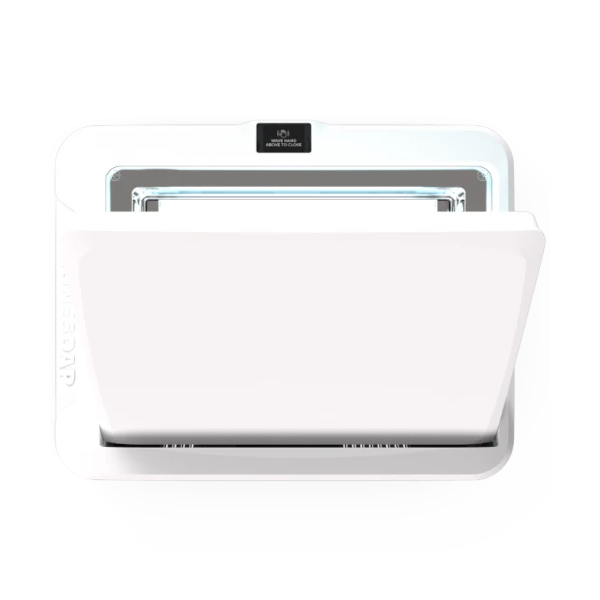
The Equipment
ExpressPro: Rapid UV Disinfector
360° UV-C disinfection for phones, tablets and shared electronics in a 15–60 second configurable cycle. Sixteen high-powered 254 nm bulbs, real quartz surfaces, wave-activated hands-free operation, motorized touchless door with manual override, OLED display, and hot-bulb regeneration between cycles.
Questions, Answered
Commercial UV-C disinfection, answered.
Is ultraviolet light disinfection the same as sterilization?
No, and the distinction matters for procurement. Sterilization means the elimination of all microbial life, including spores, and it is a regulated term applied to validated processes such as autoclaving. Ultraviolet light disinfection substantially reduces microbial load on exposed surfaces. ExpressPro disinfects hard surfaces — it is not a sterilizer and not a medical device. Equipment in this category is often searched for as a "commercial UV sterilizer," but that is not what it is, and any vendor using the word about a device chamber is overstating what the equipment does.
How long does a cycle take?
15 to 60 seconds, and it is configurable — the companion iOS app allows cycle lengths up to two minutes if a facility wants a longer dose. The published pathogen figures above name the cycle length each was measured at, because dose is a function of time.
Is UV-C safe for phones, tablets and their screens?
Yes. There are no chemicals, no liquid and no residue, so there is nothing to degrade oleophobic screen coatings, seep into ports or attack plastics and rubber gaskets. This is the most common reason facilities move shared devices off a wipe protocol.
Does it replace our existing cleaning protocol?
No. It complements it. UV-C does not remove visible soil, so a dirty device still needs wiping, and surfaces that light cannot reach are not disinfected. What ultraviolet light disinfection adds is a consistent, fast, documented layer for the shared electronics that most cleaning protocols have never really covered.
How often should shared devices be disinfected?
In clinical settings, after each patient encounter. In other shared environments, at minimum every two to four hours, and at every shift change for equipment that transfers between staff. The practical constraint is almost always cycle time, which is why the 15 to 60 second window matters more than it first appears.
What documentation can you provide for procurement and infection prevention?
The full GLP study reports for S. aureus and MRSA, C. difficile, Salmonella and human coronavirus 229E; the University of Tennessee live SARS-CoV-2 virucidal study; the Candida auris report; and the published clinical studies from Children's Hospital Los Angeles and Harvard / Brigham & Women's. Specification sheets, instructions for use, maintenance and bulb documentation are available on request.
What does commercial UV disinfection equipment cost?
An ExpressPro station is $1,500 with the wall mount included. A VESA-compatible desk stand is $179.95 and a roller stand for moving between rooms is $495.00. Volume and multi-location pricing is quoted directly — there is no published tier sheet, because deployments differ too much. For comparison, whole-room UV-C robots typically start around $8,000.
Will it handle tablets and rugged handhelds?
Most smartphones and tablets up to 12" fit. The interior measures 11.13" long by 7.50" high by 1.75" wide, which accommodates ruggedized cases on most handhelds — but measure your largest device in its case before ordering.
Tell us what your facility is disinfecting.
We will talk through cycle time against your workflow, the right mounting for the space, volume pricing, and which studies your infection prevention team will want to see.
Single units can be ordered online. Multi-unit and multi-location deployments are quoted directly.
† Testing was conducted in a laboratory setting on actual phones and devices against specific pathogens, at the cycle lengths named. Real-world results may vary depending on the size, shape and material of the item being disinfected. ExpressPro disinfects hard surfaces; it is not a sterilizer and not a medical device, and it does not replace a facility's cleaning or infection-control protocol.
Per-organism figures are cited to the laboratory and study of record above. The SARS-CoV-2 figure is from the University of Tennessee Health Science Center live-virus study and is reported as 99.99%; human coronavirus 229E was tested separately as a surrogate organism and is not a SARS-CoV-2 result. The product-level claim is 99.99%.